Fieldbuses
For EtherCAT and PROFINET, redundancy settings can be configured on the Fieldbus Settings tab.
EtherCAT
The MAC addresses stored in the boot project cannot be used in redundant operation because the boot project is transferred unchanged to the second controller during synchronization. The MAC addresses are not valid there. As a result, the redundancy editor must be used to enter addresses into the runtime system configuration on both controllers.
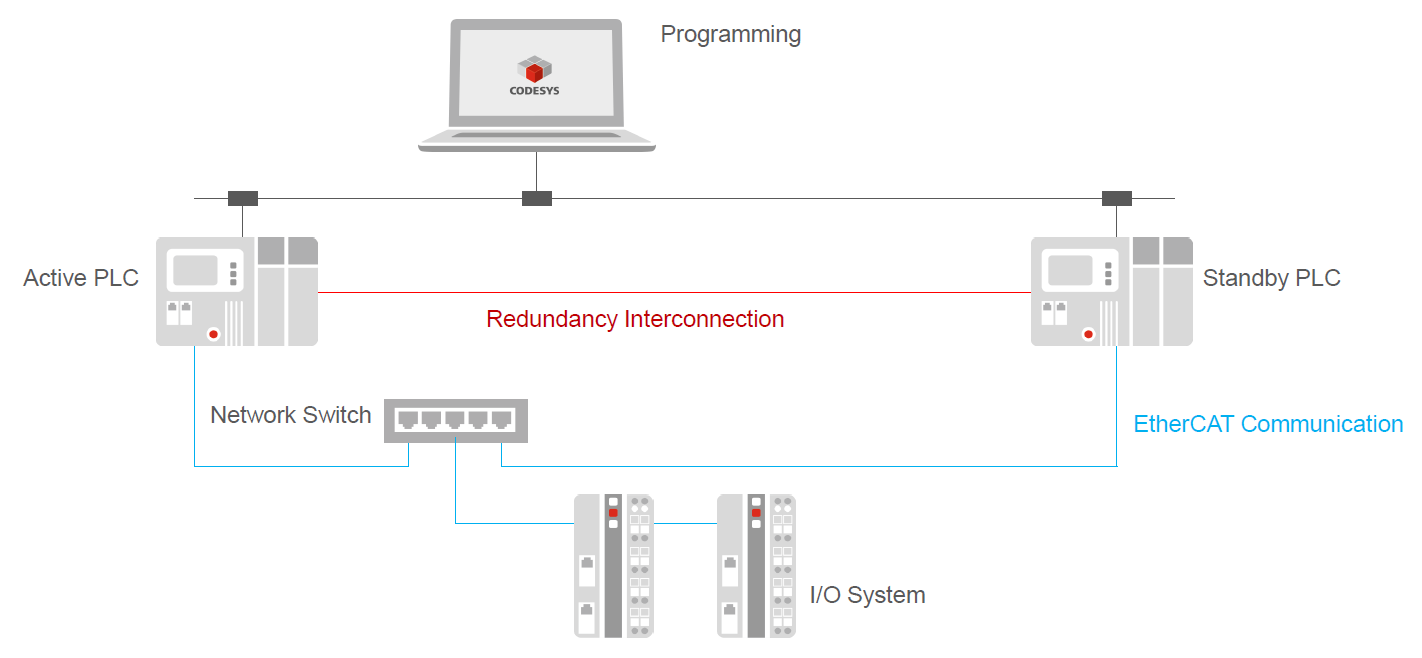
In the case of EtherCAT, a network switch is required for controller redundancy. The wiring should be done as follows:
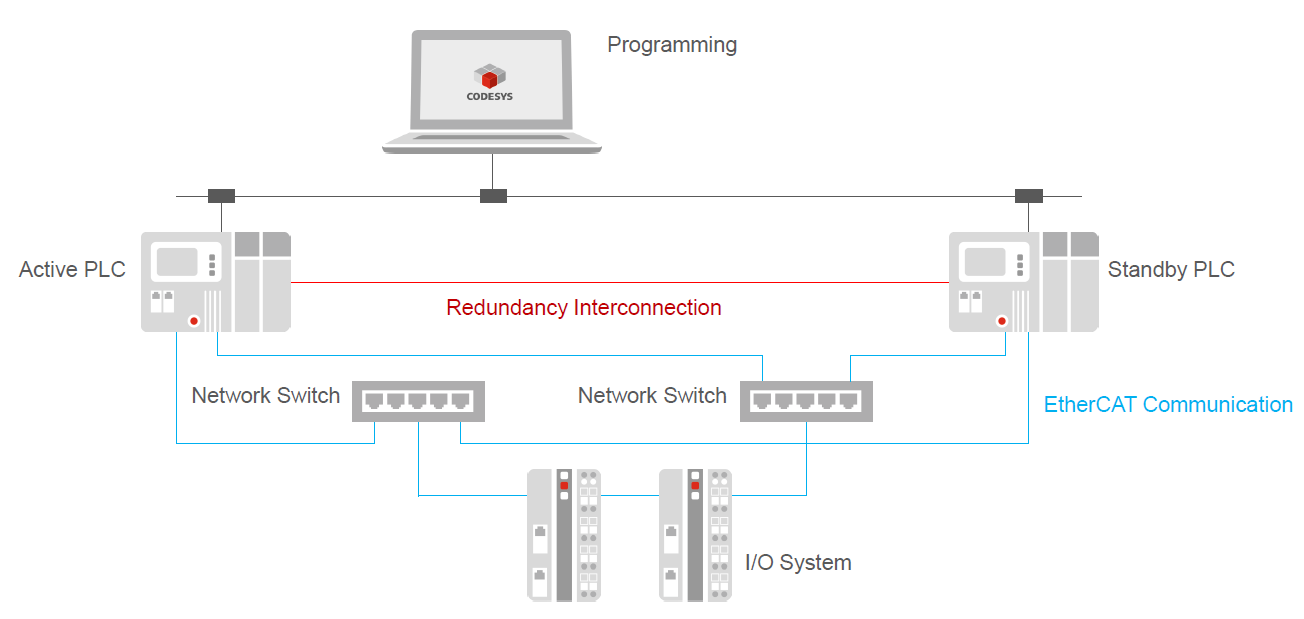
In the case of EtherCAT with controller and cable redundancy, the wiring should be done as follows:
Two network switches are required to close the ring for cable redundancy at both controllers.
Using switches in EtherCAT networks
EtherCAT generally allows the use of switches, but only under certain conditions so that real-time performance is not affected. EtherCAT supports various topologies such as line, ring, and star. Switches can therefore be used to build more complex structures. The type of switch used is crucial.
Switches can be used in EtherCAT networks, provided they do not interfere with real-time communication. Only EtherCAT-capable switches are recommended or the use of EoE. Standard Ethernet switches without EtherCAT support should be avoided.
EtherCAT-capable switches
Specialized EtherCAT switches, which can directly process EtherCAT data frames, are designed for connecting EtherCAT segments without affecting real-time capabilities. Using such switches, it is possible to connect multiple EtherCAT segments to a master. This can lead to performance improvements.
Ethernet over EtherCAT (EoE)
When using standard Ethernet switches, Ethernet devices can be connected to an EtherCAT switch. Normal Ethernet frames are tunneled through the EtherCAT protocol without affecting the real-time capabilities of EtherCAT. This increases the flexibility for using a wide variety of Ethernet devices.
Limitations of standard Ethernet switches
Standard Ethernet switches which are not EtherCAT-capable and do not use EoE tunneling cause latencies that are incompatible with EtherCAT. Their use has a negative impact on cycle times and is therefore not recommended.
PROFINET
CODESYS supports the PROFINET S2 system redundancy. The fieldbus devices used must support this S2 system redundancy.
It is recommended to use the RedundancyManager function block from the IoDrvProfinet library.
For more information, see the following: Controller Redundancy
Modbus
Redundancy is available for Modbus TCP only. This can be done by using a function block in the application. The Modbus TCP Client with CODESYS Redundancy Configuration is used via the RedundancyManager function block from the IoDrvModbusTCP library.
For more information, see the following: TCP Client Redundancy
CANopen
For information about CANopen with redundancy, see the following: CANopen Manager – Functions and Tab: CANopen Manager – General