User Interface
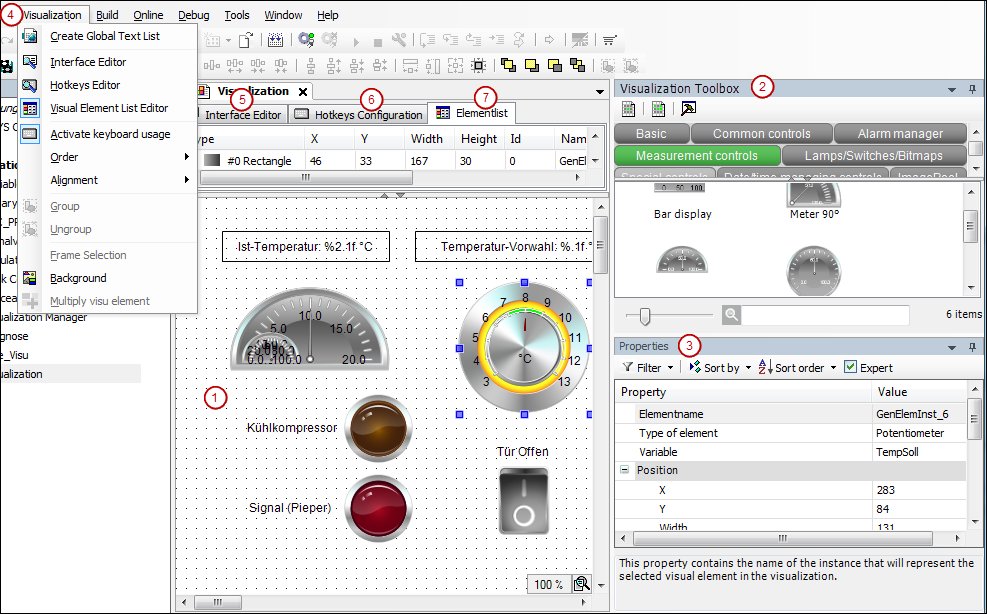
(1) | Provides the functionality for creating and editing user interfaces. | |
(2) | Enables the declaration of interface variables which are specified by the calling visualization instance. When referencing via the Frame element or Tabs element, the actual application variables will be assigned to the interface variables. At runtime, parameters (similar to a function block) are passed to the called visualization. The interface variables can be of any data type. Depending on the runtime environment, custom types may also be possible. Benefit: The interface allows a visualization to be used as a template multiple times and to be supplied with data for each instance (independently of each other). When the interface is changed, all parameter transfers are checked, and errors are detected and reported. | |
(3) | Enables the configuration of keyboard shortcuts in the entire application. | |
(4) | Lists all elements used in the visualization and allows editing of the displayed element properties (position, size, name) and the tab order. An overview of the permissions set in the element properties is provided in the Access Rights column. Benefit: The list allows editing a value while taking into account the values of the other elements. | |
(5) | The editor can be used to configure a frame interface which consists of nodes and category nodes. Element properties for visualization are defined and made public via this interface. The interface is forwarded to the referencing Frame element. The properties of the frame interface can be categorized to provide the best possible overview. In the editor, the following menu commands are available for creating, editing, and structuring nodes and category nodes: Benefit: The frame interface turns a visualization into a custom element with configurable properties which can be reused any number of times. Value assignments are made (just like with installed elements) in the Properties view. Inputs can be supported by the various editor types. This achieves behavior which is typical for a visualization element. |
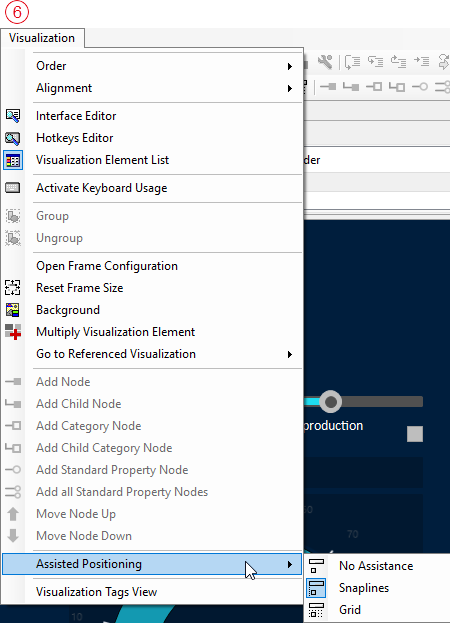
(6) | Menu: Visualization | Provides the menu commands for the visualization. |
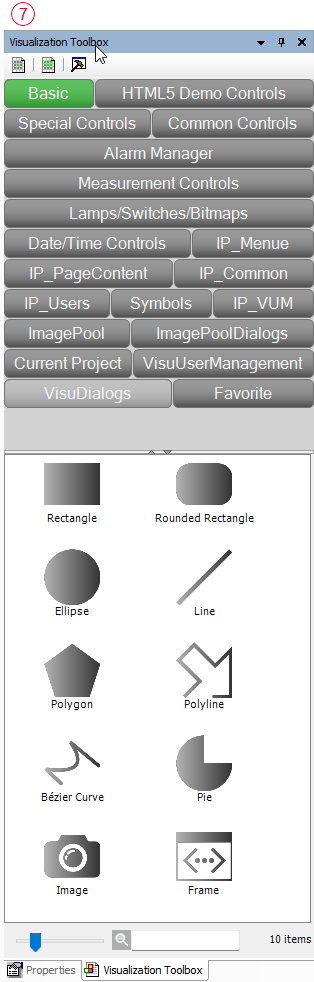
(7) | View: Visualization Toolbox | Provides the installed visualization elements |
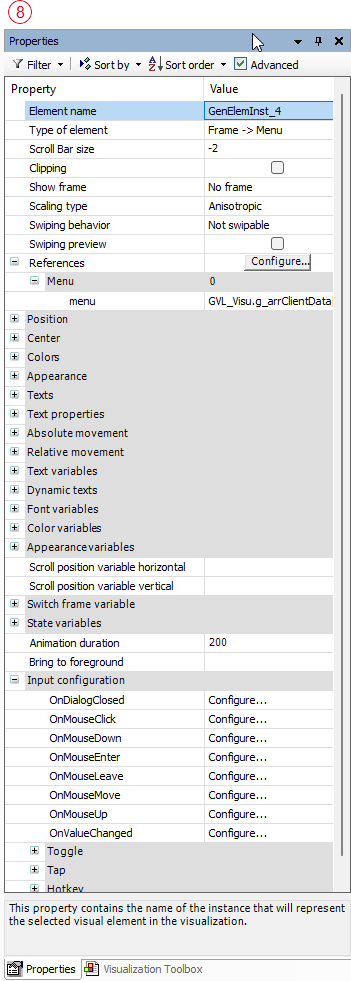
(8) | View: Properties | Lists the properties of the element selected in the visualization editor and allows values to be passed to the element properties. |